


Key Takeaways On Heat Reflecting Windows:
- The “Mirror” Effect: It reflects heat out in the summer and keeps warmth in during the winter.
- UV Protection: It prevents the sun from fading your furniture and flooring.
- Lower Utility Bills: Less AC “cycling” means more money stays in your pocket.
In the sweltering Houston climate, your windows are often the biggest culprit for rising indoor temperatures. Heat reflecting windows are engineered with a microscopic, metallic “Low-E” (low-emissivity) coating designed to act like a thermal mirror; they reflect the sun’s intense infrared light and UV rays away from your home while still allowing natural visible light to pour in.
By blocking this solar heat gain before it enters your living space, these windows significantly reduce the workload on your air conditioning system.
The result of heat reflecting windows is a more consistent indoor temperature and a dramatic drop in monthly energy consumption, turning your home into a cool sanctuary even during the peak of a Texas summer.
Why Are Single Pane Windows So Inefficient?
Single-pane windows are not heat reflecting windows. They are essentially “open doors” for heat. While they appear to be solid barriers, from a physics standpoint, they lack the two most critical components required to stop Houston’s heat: thermal resistance (insulation)and low-emissivity (reflection).
Here is why they fail so significantly in the Texas sun:
1. Glass is a Natural Heat Conductor
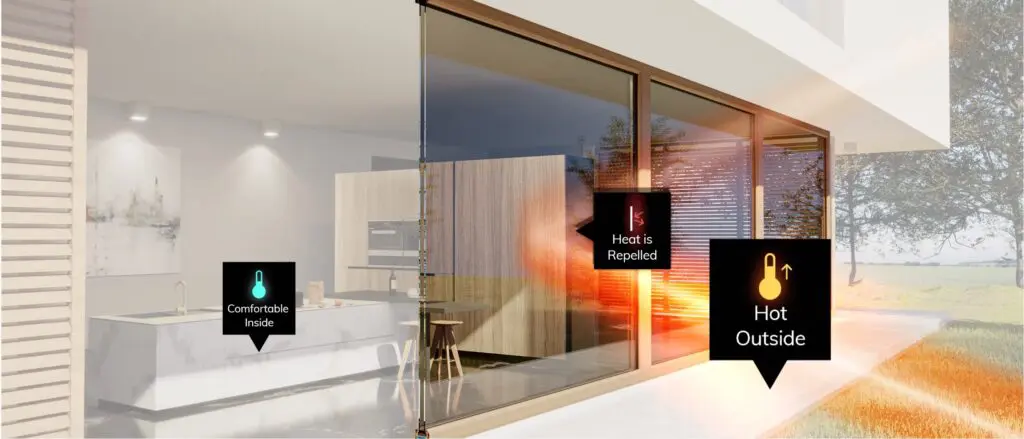
Standard window glass is not an insulator; it is a thermal conductor. When the 100°F Houston sun hits a single pane of glass, the heat doesn’t stay outside. The glass absorbs that thermal energy, heats up, and then radiates that heat directly into your living room.
Because there is only one layer, the heat transfer is almost instantaneous. In technical terms, a single pane of glass has an R-value of about 1, which provides virtually no resistance to heat flow.
2. Absence of an Insulating Buffer
Modern energy-saving windows use two or three panes of glass to create a “dead air space” or a gas-filled chamber (using Argon or Krypton).
- Single Pane: Heat moves directly through the solid material.
- Double/Triple Pane: The heat must jump across a gap of air or dense gas. Since air and gas are poor conductors of heat, this gap acts as a “speed bump,” dramatically slowing down the energy transfer.
3. Low-E Coating Limitations
“Heat-reflecting” ability comes from Low-E (Low-Emissivity) coatings, which are microscopic metallic layers.
- On a single pane, these coatings are rarely used because they are exposed to the elements (dust, humidity, and cleaning chemicals), which causes them to scratch or oxidize quickly.
- In double-pane windows, the coating is safely tucked away inside the sealed gap between the panes, allowing it to reflect up to 70% of solar heat without ever wearing off.
4. The “Radiator” Effect
On a typical Houston summer afternoon, a single-pane window can reach temperatures high enough to burn your hand. Once the glass is hot, it acts like a space heater inside your house. Even if your AC is blasting, you will feel a “hot spot” near the window because the glass is constantly emitting infrared radiation into the room.
Does Adding A Second Pane Of Glass Solve The Problem?

Not completely. While switching to a standard double-pane window is a significant step up from a single pane, they are still not heat reflecting windows. Double-pane windows are primarily designed for insulation; the pocket of air or argon gas between the glass layers acts as a thermal buffer that slows down the conduction of heat. However, standard clear glass is still highly transparent to radiant heat (infrared energy). Without a specialized coating, the sun’s rays can pass right through both panes of glass, heating up your furniture, floors, and air just like a greenhouse. In a climate like Houston’s, where the sun is the primary source of discomfort, insulation alone isn’t enough—you also need a way to reflect that radiant energy back to the outside before it ever enters your home.
Why Insulation Is Not Reflection
To truly defeat the Texas heat, your windows need to address two different types of heat transfer:
- Conduction (The Air Gap’s Job): Stops heat from “soaking” through the window materials.
- Radiation (The Coating’s Job): Stops the sun’s rays from “shining” heat into your room.
While the two panes and the gas-filled gap are great for insulation, they don’t actually reflect heat. The specific feature that gives a window its “reflective” power is a microscopically thin, transparent layer called a Low-E (Low-Emissivity) coating.
The Low-E Coating: A “Heat Mirror”
A Low-E coating is a series of ultra-thin layers of metallic oxides (often including silver) applied to the surface of the glass. It is so thin—hundreds of times thinner than a human hair—that you can see right through it, but it interacts with light in a very specific way:
- Admits Visible Light: It allows the light we use to see to pass through clearly.
- Reflects Infrared Light (Heat): It acts like a mirror for “long-wave” and “short-wave” infrared energy. In Houston, this means it bounces the sun’s burning radiant heat back outside before it can warm up your home.
Why it’s hidden inside the window
In a double-pane unit, this coating is typically applied to the inside-facing surface of the outer pane (known to professionals as “Surface #2”).
What Brands Does Houston Window Experts Offer?
Houston Window Experts offers nearly 2 dozen of the best windows available in the industry. Here are links to just a few:

Putting the coating there is a strategic move:
- Protection: Because the metallic layers are delicate, they are sealed inside the airtight space between the two panes. This protects the coating from being scratched by cleaning or oxidized by the humid Houston air.
- Performance: Placing it on the outer pane allows the window to reflect the heat before it even crosses the insulating air gap, keeping the interior pane—and your home—significantly cooler.
The “Thermos” Effect
Think of a high-end double-pane window like a vacuum-sealed thermos. The air (or argon gas) between the panes is the insulator that stops heat from “soaking” through, but the Low-E coating is the silver lining that reflects the temperature back to its source.
Start Saving With Heat Reflecting Windows!
Call us or complete one of our contact forms to start your free, no-obligation, in-home estimate for heat reflecting replacement windows.
Stop by our Houston Showroom to see our brands (nearly 2 dozen of the Best Products)! Experience our staff.
You’ll quickly discover some of the Best People in the industry. Choose Houston Window Experts and experience Best Processes resulting in Lifetime Leak-Free Guarantee! Check out our current specials!
Hope to see you soon!